What Is RPM on YouTube?
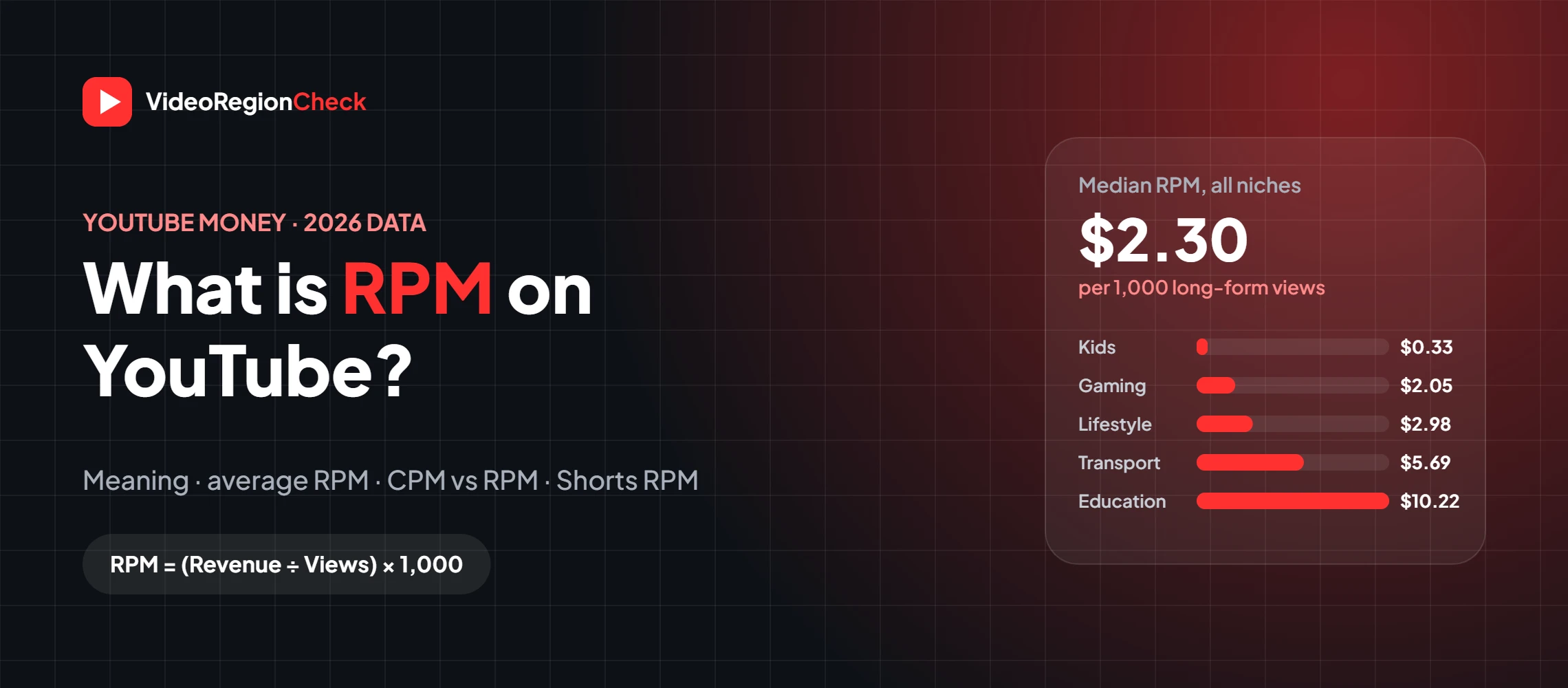
RPM is what you actually earn per 1,000 views on YouTube. Here’s what it means, how it differs from CPM, the 2026 average by niche and for Shorts, and how to raise yours.
In this article
If you’ve opened the Revenue tab in YouTube Studio, you’ve seen two numbers that look almost the same: RPM and CPM. Only one of them tells you what you actually earn. That number is RPM, and once you understand it you can estimate your income, compare videos and spot what’s holding your earnings back.
This guide explains what RPM on YouTube means, how it differs from CPM, what the average YouTube RPM is in 2026 by niche and for Shorts, and practical ways to increase it.
Key takeaways
- RPM = revenue per 1,000 views after YouTube’s share, from ads, Premium, memberships and fan funding.
- CPM is what advertisers pay per 1,000 ad impressions. RPM is what you keep, so it’s always the more useful number.
- The 2026 median long-form RPM is about $2.30. Education is the highest-paying niche, at around $10.22.
- Shorts RPM is usually $0.01–$0.07 per 1,000 views.
- Your niche, audience country, video length and retention move RPM the most.
What is RPM on YouTube?
RPM (revenue per mille) is the amount of money you earn for every 1,000 views on YouTube. “Mille” is Latin for thousand. YouTube calculates it after its revenue share, so RPM reflects your real take-home earnings, not what advertisers paid.
RPM counts revenue from every source YouTube pays you through:
- Ads on your long-form videos and Shorts
- YouTube Premium (a share of members’ subscription fees, based on how much they watch you)
- Channel memberships
- Super Chat, Super Stickers and Super Thanks
The formula is simple:
RPM = (Total estimated revenue ÷ Total views) × 1,000
Example: you earn $450 from 150,000 views. ($450 ÷ 150,000) × 1,000 = $3.00 RPM.
Because RPM is based on all views, including the ones that didn’t show an ad, it is the fairest way to answer “how much does YouTube pay me per 1,000 views?”. If you want to turn any RPM into an earnings estimate, our YouTube Money Calculator does the maths for you.
Difference between CPM and RPM
CPM and RPM both measure money per 1,000 of something, but they look at the money from opposite sides.
| CPM (cost per mille) | RPM (revenue per mille) | |
|---|---|---|
| Measures | What advertisers pay per 1,000 ad impressions | What you earn per 1,000 video views |
| Before or after YouTube’s share | Before | After |
| Counts views without ads | No, only monetized playbacks | Yes, all views |
| Includes Premium, memberships, Super Chat | No, ads only | Yes |
| Typical size | Higher | About 40–60% of CPM |
| Best for | Judging how valuable your audience is to advertisers | Estimating your real income |
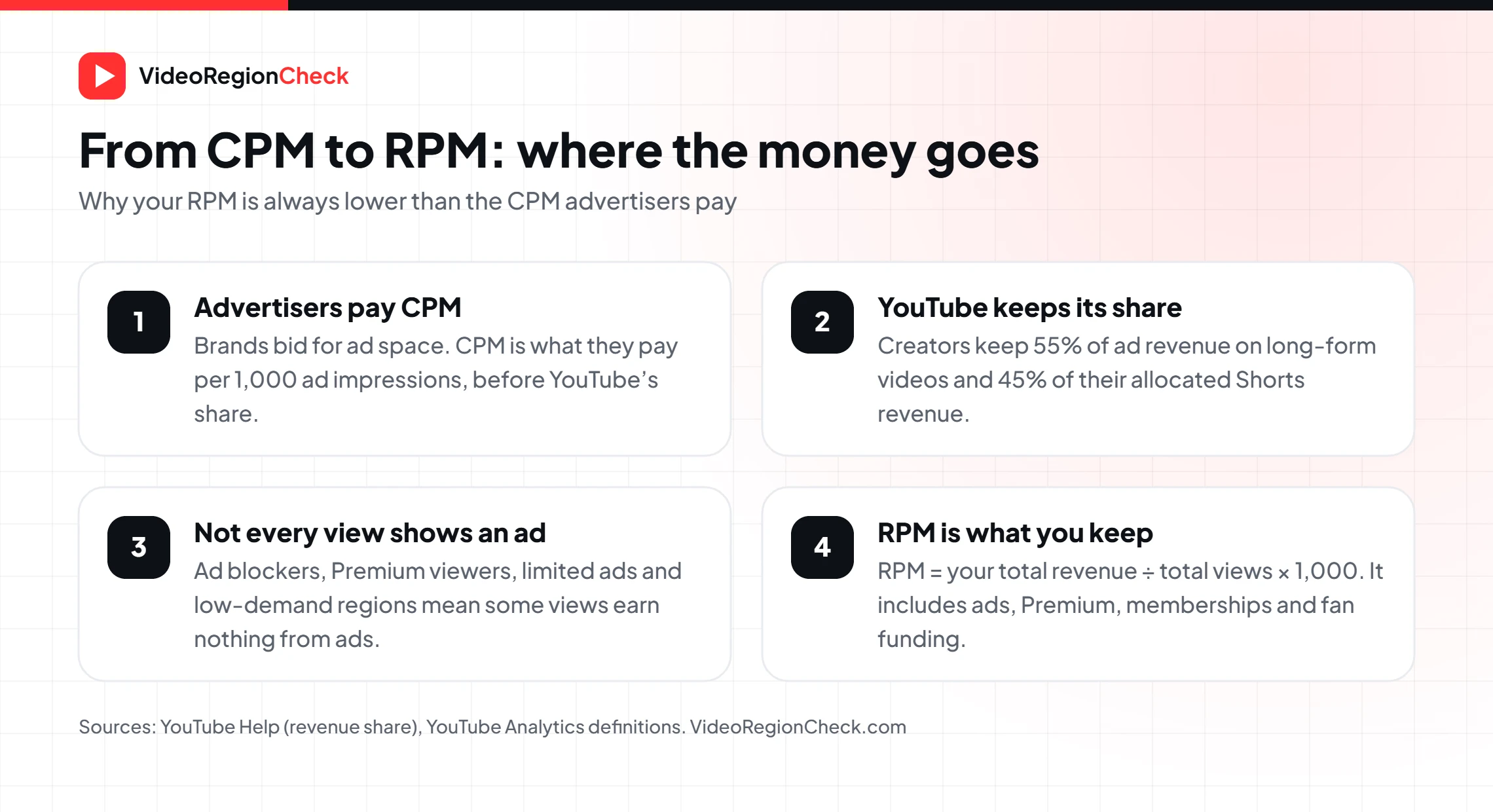
Two things shrink CPM into RPM. First, YouTube’s revenue share: creators keep 55% of ad revenue on long-form videos and 45% of the revenue allocated to them on Shorts (YouTube Help). Second, not every view is monetized, because of ad blockers, Premium members, limited ads and regions with little ad demand. A video with a $6 CPM might end up around a $2.50 RPM.
YouTube RPM average in 2026
Across all niches, the median YouTube RPM in 2026 is about $2.30 for long-form videos. That comes from AIR Media-Tech’s study of 300 monetized channels, covering every monetized month from May 2025 to May 2026. Most channels sit somewhere between $1 and $5, with a long tail of high earners.
Highest RPM niches on YouTube
Your topic decides which advertisers want your audience, which makes it the biggest single driver of RPM. Here’s the 2026 breakdown:
| Niche | Median RPM | Typical RPM range | Median Studio CPM |
|---|---|---|---|
| Education & Science | $10.22 | $2.31 – $19.50 | $5.91 |
| Transport* | $5.69 | $3.17 – $9.81 | $5.88 |
| Lifestyle | $2.98 | $1.77 – $5.24 | $5.32 |
| News & Politics* | $2.60 | $1.79 – $3.62 | $4.51 |
| Entertainment | $2.43 | $0.88 – $5.02 | $3.98 |
| Crafting & Handmade | $2.39 | $1.00 – $3.90 | $3.42 |
| Gadgets & Tech | $2.33 | $0.70 – $3.71 | $5.73 |
| Music | $2.28 | $1.35 – $4.16 | $4.05 |
| Food & Cooking* | $2.25 | $1.50 – $3.11 | $4.04 |
| Gaming | $2.05 | $0.70 – $3.62 | $4.05 |
| Business & Finance* | $2.01 | $0.73 – $5.17 | $4.84 |
| Health & Sport | $1.23 | $0.72 – $1.53 | $3.54 |
| Kids & Teens | $0.33 | $0.16 – $0.88 | $1.59 |
* Fewer than ten channels in the sample, so treat these as directional. Typical range = middle 50% of channels.
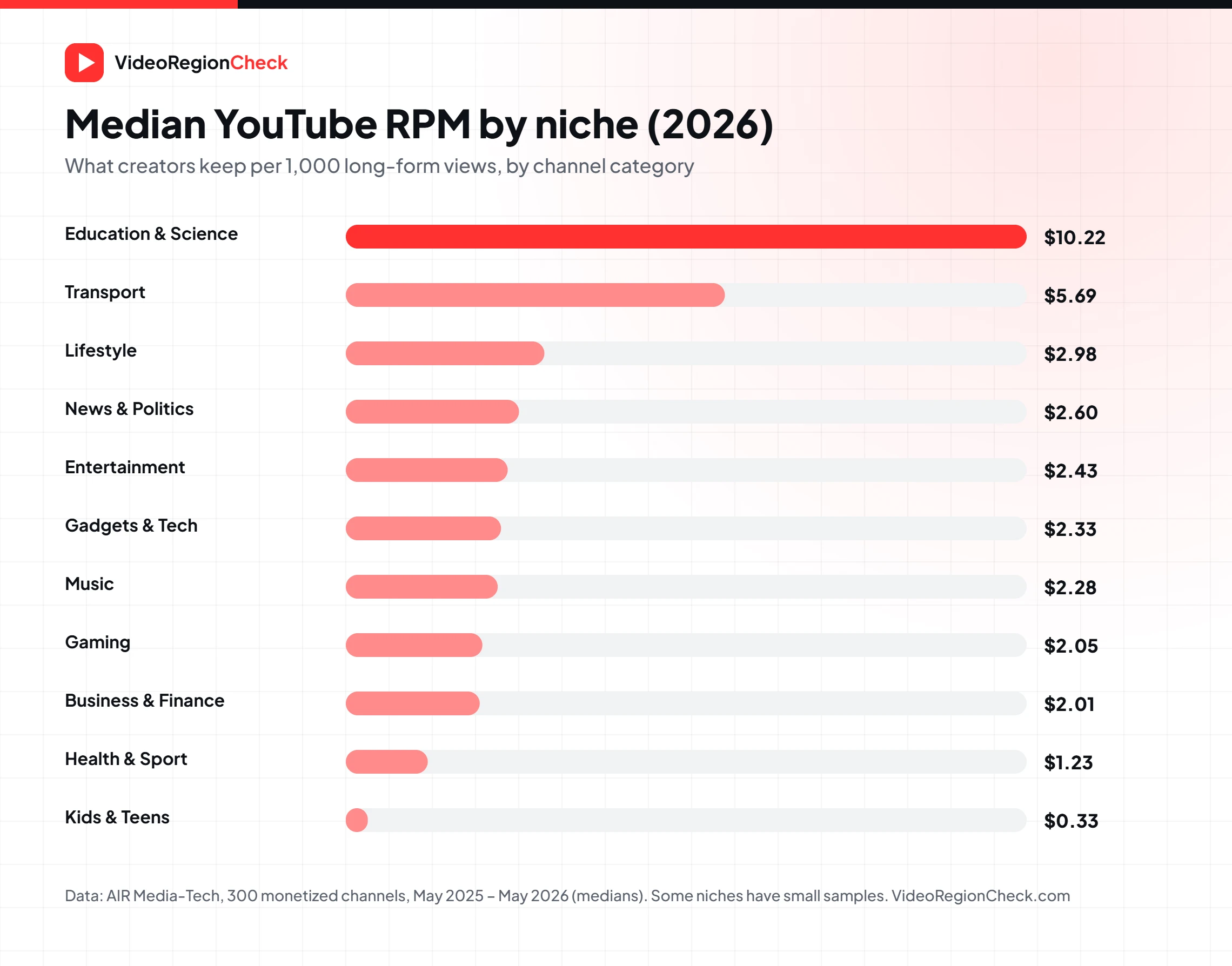
Education & Science leads by a wide margin. Kids content earns the least, because ads on made-for-kids videos can’t be personalised. Notice how wide the ranges are: two channels in the same niche can earn five or ten times differently. Other 2026 reports put US-focused personal finance, insurance and software channels at $10–$25+ RPM, so audience location matters as much as category. Not sure which category your channel falls into? Check it with the YouTube Channel Category Checker.
What’s a good RPM on YouTube?
A “good” RPM depends on your niche and format. Use this as a rough benchmark for long-form videos:
| Long-form RPM | What it usually means |
|---|---|
| Under $1 | Low. Common for kids content, short videos or audiences in low-CPM countries. |
| $1 – $3 | Typical. Around the 2026 median for entertainment, gaming, music and lifestyle. |
| $3 – $6 | Good. Often how-to, tech and lifestyle channels with US/UK viewers. |
| $6 – $10 | Excellent for most niches. |
| $10+ | Top tier. Usually education, finance, software or B2B with a strong US audience. |
Compare your RPM with channels in your own niche rather than with the internet’s best screenshots. A $2 gaming channel is doing fine; a $2 personal finance channel has room to grow.
YouTube Shorts RPM
Shorts are paid differently from long-form videos. Ads that run between Shorts in the feed go into a shared pool, music licensing costs come out, and the rest is split by each creator’s share of Shorts views. Creators then keep 45% of their allocation.
As a result, RPM for YouTube Shorts is usually $0.01–$0.07 per 1,000 views in 2026, and up to around $0.30 for strong US-audience channels in high-value topics. That’s roughly 30–100 times less than a typical long-form RPM.
| Format | Typical RPM | Earnings from 1M views |
|---|---|---|
| Shorts (typical) | $0.01 – $0.07 | $10 – $70 |
| Shorts (strong US audience) | up to ~$0.30 | up to ~$300 |
| Long-form (2026 median) | ~$2.30 | ~$2,300 |
Coming in 2027: according to YouTube’s August 2026 announcement, from February 1, 2027 a channel needs 10 million qualified Shorts views in the last 90 days to earn Shorts ad and subscription revenue. Below that, long-form earnings continue as normal.
For a closer look at what a viral video earns, read how much YouTube pays for 100K views.
What affects your YouTube RPM?
- Niche and topic: advertisers pay more to reach people close to buying, for example software, finance or courses.
- Audience country: US, UK, Canadian and Australian viewers bring the highest CPMs.
- Video length: videos of 8 minutes or longer can carry mid-roll ads.
- Watch time and retention: viewers who stay longer see more ads.
- Ad suitability: limited-ad (yellow icon) videos earn far less.
- Format mix: a channel with many Shorts views will have a lower overall RPM.
- Season: RPM peaks in Q4 (October–December) and usually dips in January.
- Audience age: made-for-kids content can’t show personalised ads, so RPM is much lower.
How to increase RPM on YouTube
You can’t control advertiser budgets, but you can control a lot of what decides your RPM. Here’s how to get a higher RPM on YouTube:
Make longer videos when the topic needs them
At 8+ minutes you can place mid-roll ads. Let YouTube place them automatically, or add natural breaks yourself.
Target high-value topics in your niche
Within any niche, videos about buying decisions, tools, software and money attract better-paying advertisers. Research keywords with the YouTube Tag Generator.
Grow your US, UK, Canadian and Australian audience
Use English titles, references and upload times that suit those markets. Check Top geographies in YouTube Analytics.
Improve retention
Strong hooks, tight editing and clear chapters keep viewers watching, which means more ad impressions per view.
Keep videos advertiser-friendly
Avoid profanity in the first 30 seconds, graphic content and sensitive titles or thumbnails that trigger limited ads.
Turn on all ad formats
In YouTube Studio, enable pre-roll, post-roll, skippable and non-skippable ads for each eligible video.
Add non-ad income
Memberships, Super Thanks and Super Chat count toward RPM, so they raise it without needing more views.
Publish your best videos in Q4
Advertisers spend the most from October to December. Plan important uploads for that window.
Where to find your RPM in YouTube Studio
- Open YouTube Studio and select Analytics.
- Go to the Revenue tab.
- Your RPM card shows the figure for the selected date range. Click it to see RPM over time.
- To compare videos, open Advanced mode and add the RPM metric to the table.
RPM only appears once your channel is in the YouTube Partner Program. To look at public stats for any video, including engagement and an earnings estimate, try YouTube Video Analytics.
Frequently asked questions
What does RPM mean in YouTube?+
RPM stands for revenue per mille, or revenue per 1,000 views. It shows how much money you actually earned for every 1,000 views on your channel or video, after YouTube’s revenue share, from all sources: ads, YouTube Premium, channel memberships, Super Chat, Super Stickers and Super Thanks.
What is the average RPM on YouTube?+
In 2026 the median long-form RPM across niches is about $2.30, based on AIR Media-Tech’s data from 300 monetized channels. Most channels fall between roughly $1 and $5, while education channels with US and UK audiences often earn $10 or more.
What is a good RPM on YouTube?+
For long-form videos, $3–$6 is good for most niches and anything above $6 is excellent. A good RPM depends on your niche: $2 is solid for gaming, but low for education or software. For Shorts, $0.05–$0.10 is good.
What is the RPM for YouTube Shorts?+
Most Shorts earn about $0.01–$0.07 per 1,000 views in 2026. Channels with mostly US viewers and high-value topics report up to around $0.30. Shorts RPM is much lower than long-form because revenue comes from a shared pool and Shorts carry fewer ads.
What is the difference between CPM and RPM?+
CPM is what advertisers pay per 1,000 ad impressions, before YouTube takes its share. RPM is what you earn per 1,000 video views after YouTube’s share, counting views that showed no ads and including non-ad income. RPM is the number that matches your real earnings.
Why is my YouTube RPM so low?+
The usual reasons are a low-paying niche, a large share of viewers in low-CPM countries, short videos without mid-roll ads, many views from Shorts, limited-ad (yellow icon) videos, or a young audience. RPM also drops every January after holiday ad budgets end.
Can RPM be higher than CPM?+
Rarely. RPM is usually 40–60% of CPM because of YouTube’s revenue share and unmonetized views. It can come close to or above CPM on channels that earn a lot from memberships, Super Chat or Premium, because those count toward RPM but not CPM.
The bottom line
RPM is the clearest measure of what YouTube actually pays you: revenue per 1,000 views, after YouTube’s share, from every source. The 2026 median is about $2.30 for long-form videos and a few cents for Shorts, but niche and audience country can push it far higher. Track your RPM in YouTube Studio, compare it with your niche, and work on the levers you control: video length, retention, topic choice and extra income from memberships and fan funding.
Related articles
 BlogHow to Delete YouTube Comments (Mobile & PC)Delete YouTube comments on mobile and PC: remove your own comments, find them in Comment History, clear many at once,…
 BlogHow to Get Verified on YouTube in 2026 (Free)How to get the YouTube verification badge for free: 2026 requirements (100K subscribers), how to apply in YouTube Studio, and…
 BlogHow to Improve YouTube Video Quality on UploadYouTube video quality bad after upload? Learn why videos look blurry, YouTube’s recommended export settings and bitrates, and how to…